
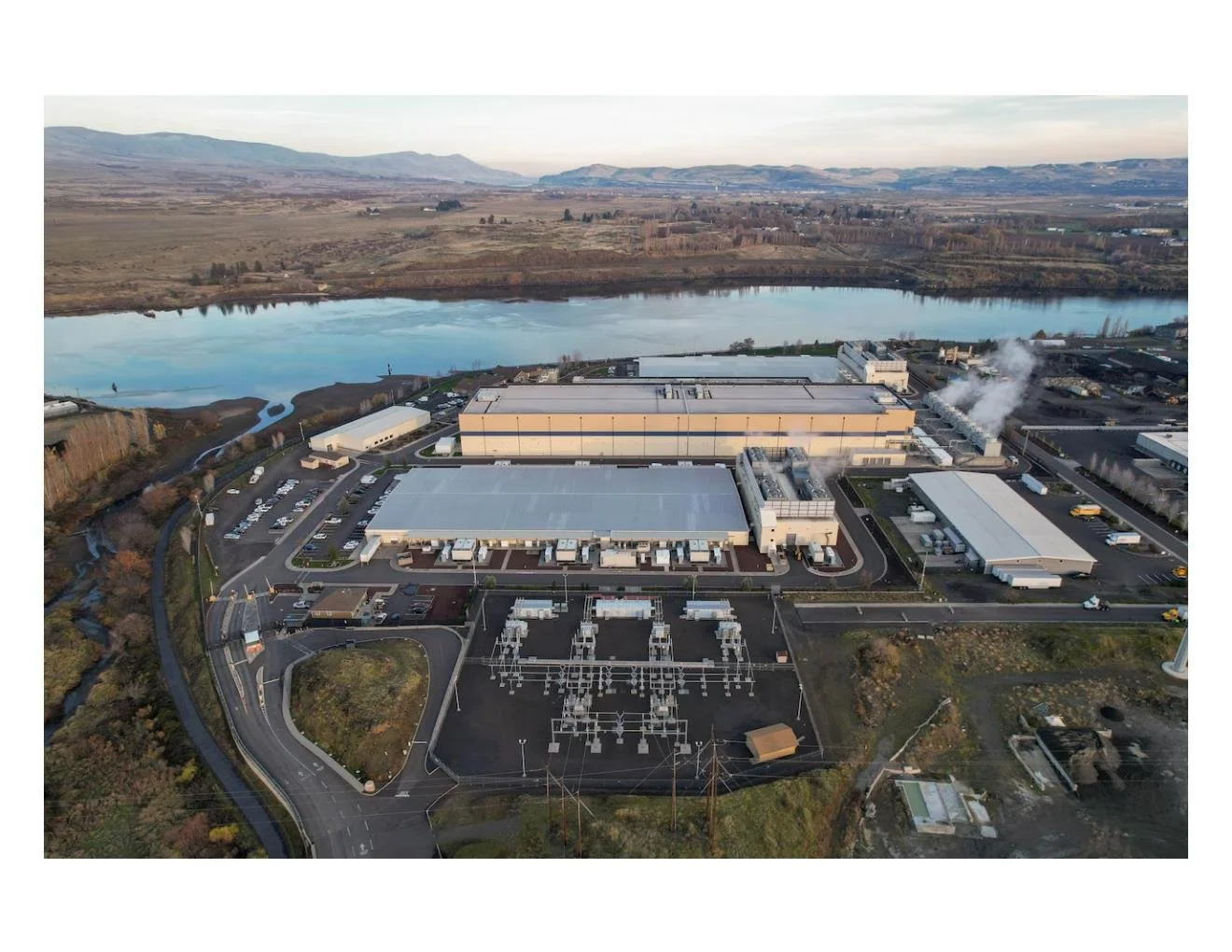
Oregon is attracting new data centers through property tax exemptions. Who is going to pay for the grid upgrades they require?
Keeping Up With Demand
Oregon’s electrical grid and utility costs have been relatively stable since 1988 when our energy use transitioned from fuel oil and wood to natural gas and electricity. Over the past 8 years, that stability we have come to rely on has been shifting, as the state is experiencing a dramatic increase in the demand for electricity. A lot of people have associated these increases with more households and cars transitioning to electric. We decided to take a look at this and found that there is a much bigger elephant in the room.
About 8 years ago Amazon, Facebook, Apple, and Google started bringing large data centers online across Oregon and Washington. These new centers are putting massive amounts of pressure on our aging infrastructure, and are requiring a lot more energy and transmission lines than we currently have. Historically, utility companies have passed these costs on to all the rate payers. Meaning, residential rate payers will be paying the bulk of the upgrades that these large data centers require.
In 2012, PGE started tracking energy use by the class of customer, i.e. residential, commercial, and industrial. The graph below shows that residential energy use has not changed since 2012, while industrial energy is increasing at an unprecedented pace.
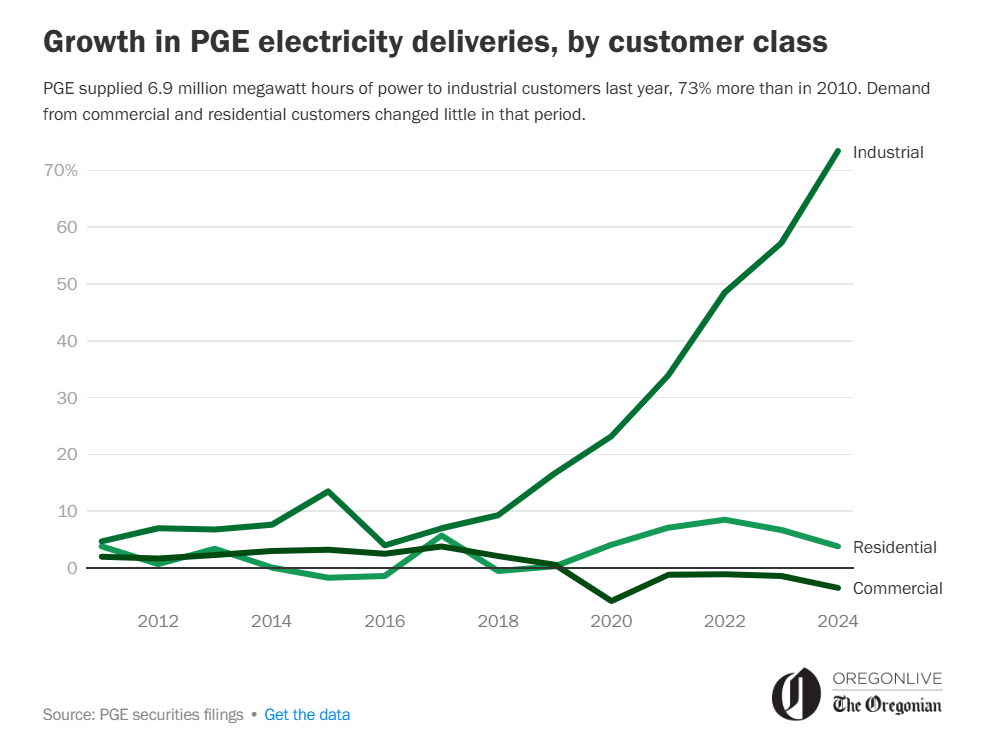
Image from Oregon Live showing energy useage from PGE since 2012 by class type
Your Electric Bill
This increase in demand has already started to impact residential energy bills. A 2024 biennial report from the Oregon Department of Energy found that:
A typical residential customer of PGE or PacifiCorp saw their average bill increase 50-60 percent, from roughly $100/month in January 2020 to roughly $150-160/month in January 2024. Both PGE and PacifiCorp are seeking to raise rates further in 2025.
The Oregon Legislature has recognized the problem and has gathered its own bit of data to help tell the story. While PGE and Pacific Power have added over 24k residential customers to the system, the Data Center growth has been equivalent to almost 7 times that in the past 5 years.
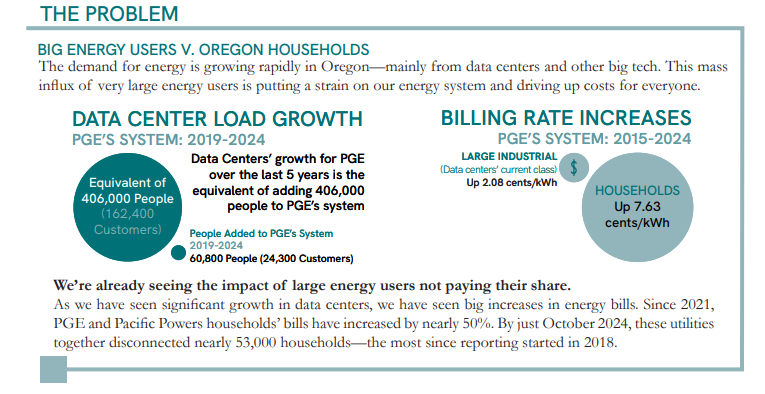
Image from Oregon Legislature on HB3546 explanitory page
Since 2015, residential rate payers have seen rate increases as high as $7.63 per kWh, while industrial scale users have only seen increases of $2.08. If our rates continue to increase with the energy appetite of Data Centers, we are going to be in big trouble fast. Energy costs have a significant inflationary effect across our entire economy.
Power Act
In June of last year, the Oregon Legislature passed House Bill 3546, aka the Power Act. It requires energy companies to distinguish the energy use profiles of different customer classes in order to require each class to pay for their own infrastructure upgrades. The details of how it will be implemented are still being worked out.
Governor Kotek named a panel earlier this year to oversee Data Centers' energy usage. The Data Center Advisory Committee is made up of climate and energy professionals. They are tasked with studying the impact of these Data Centers, and making implementation recommendations prior to the 2027 legislative session next January.
We are already starting to see pushback from the utilities themselves. Last Fall, PGE submitted a proposal to the Oregon Public Utility Commission, which is a utility-funded agency tasked with managing the utility rates. After reviewing the proposal, the watchdog group Citizens Utility Board, has accused the utility of undermining the Power Act by continuing to shift costs onto customers.
This is gearing up to be a hot-button issue. As of January 23rd 2026, the Public Utility Commission had received 1,642 public comments on PGE’s proposal. This is the second most on any issue since 1987.
Take Political Action
Public pressure has already proven to have a big impact on this conversation. Here are a couple ways you can get involved.
Commenting on the PGE proposal
The comment period is currently open and will likely end sometime this year. If you would like to add your opinion to the record, you can view or submit a comment here. The public pressure has brought PGE back to the table. This is proof that our voices matter.
Get Involved with Citizens Utility Board
The Citizens Utility Board is a watchdog agency focused on keeping energy flowing to everyone reliably, equitably, and ethically. They were instrumental in the Power Act passing, and they work tirelessly to increase clean and affordable energy in Oregon. Sign up for their newsletter to stay informed and learn about how to get involved. You can also attend one of their virtual training sessions on how to take direct action.
Take Personal Action
Another way to help insulate yourself from these energy rate increases, is to make energy improvements on your home. Improving the envelope of your home will reduce the impact of the impending energy increases and grid instability. Historically, the costs of energy upgrades rarely penciled out because utilities have remained fairly low. Based on the trajectory we are seeing, this calculus is going to start changing. Additionally, investing in the envelope of the home can also allow you to survive longer periods without power, reduce the amount of backup power you require, improve indoor air quality and comfort, and reduce instances of mold.
Whether it is solely for energy upgrades or part of a remodel, Harka can help you make smart energy investments to your home or business that are also non-toxic. We will be writing about this in more detail in the coming months. In the meantime, please reach out if you are curious about how we can help you design for tomorrow’s climate.
Next month we will post about how personal AI use can impact your energy profile, and how we may want to reconsider what we are using AI tools for.