
Many of us grew up with parents who hounded us to turn off the lights, close the front door, and for the love of all things holy, shut the refrigerator! Those habits stuck, and the constant reminder of energy costs became ingrained.
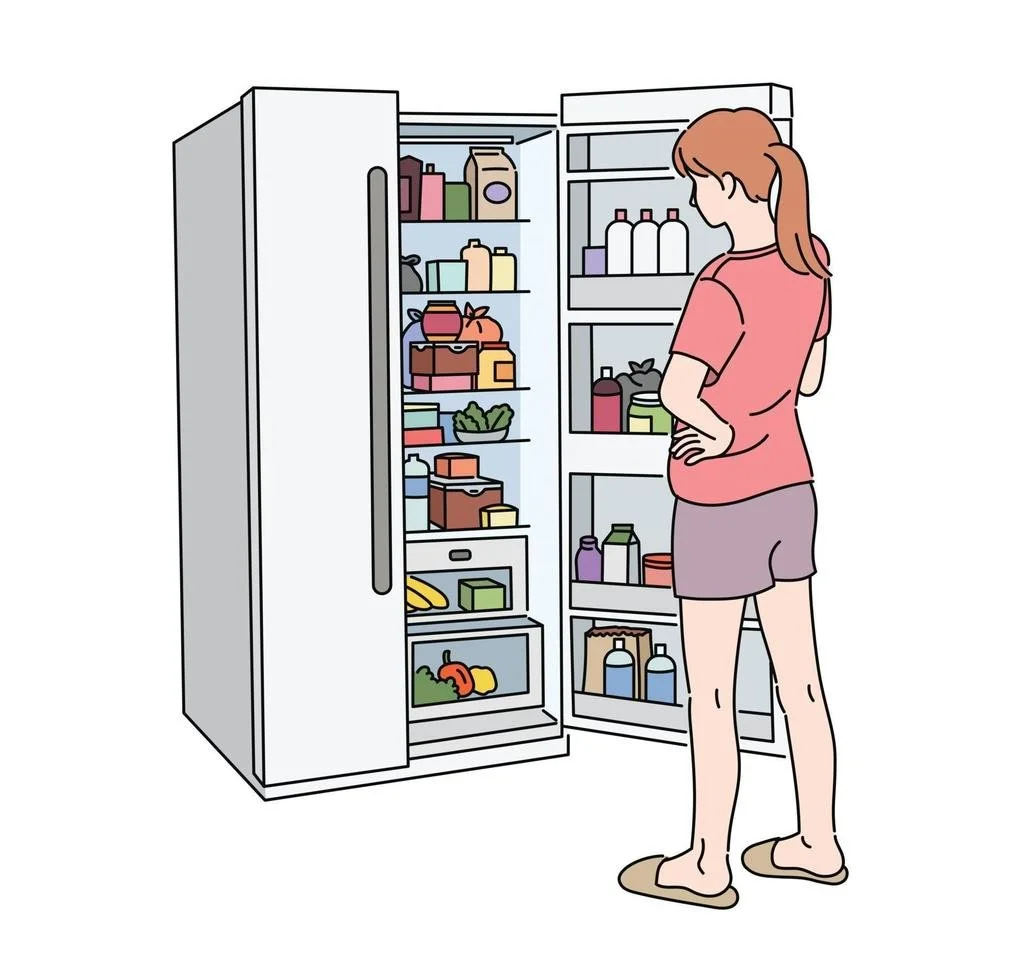
Image of someone staring at an open refridgerator taken from Vecteezy.com
Over time, technology improvements have resulted in more efficient lighting, heating systems, and refrigerators, and these conservation instincts have become less impactful. However, I still have a visceral reaction when I see someone staring into an open fridge. My motivation has shifted to lowering my carbon footprint and considering peak loads and dirty grids.
We have become more reliant on technology, and with that comes a heavier reliance on electricity. We store mountains of data in the cloud, stream music all day, and ask AI to make videos of our dogs discussing politics, but we have very little to no sense of the energy cost. Mom and Dad are not looking over our shoulders to tell us to stop streaming when we're not listening, or to delete the thousands of blurry photos we'll never look at again.
-
These companies use enormous amounts of energy can we, as consumers, have an impact on how much energy these data centers use?
Furthermore, most of this energy impact is seemingly someone else’s problem. Using AI and accessing cloud data uses very little household energy, but as we learned in last month’s SLOG post on The Impact of AI on Oregon's Energy Grid, this is becoming a significant problem. These companies use enormous amounts of energy, and the consequences are affecting us through higher utility bills, grid instability, and pollution. Can we, as consumers, have an impact on how much energy these data centers use?
In May 2025, MIT Technology Review published an excellent article by James O'Donnell and Casey Crownhart called “We did the math on AI’s energy footprint. Here’s the story you haven't heard.” They took a comprehensive look at AI's energy use all the way down to the personal level, and they found that not all AI queries are equal. Below are some of the highlights of their findings along with a calculation we did ourselves, comparing it to something we all understand: leaving the fridge open.
AI companies currently have no legal obligation to track or disclose their energy consumption, which means we have no way of knowing how much power they use, or what it takes to run a single query. So O'Donnell and Crownhart created estimates by using open-source models, and then measured the energy use.
This is a taste of the graphics that can be found in the MIT Technology Review Article
What they found.
The study tested a range of Large Language Models (LLMs), from a smaller 8-billion-parameter model to a larger 400-billion-parameter one. Parameter count is roughly a measure of how "smart" a model is and also how much energy it consumes. Task complexity matters too: the more demanding the question, the more energy required.
-
A single query is roughly equivilant to leaving your fridge open for less than a second.
For a single query, energy use ranged from 114 to 3,353 joules depending on complexity. To put that in perspective, that's the equivalent of riding 6 to 400 feet on an e-bike or leaving your refrigerator open for about 0.1 to 0.5 seconds. Not something your mother would notice.
Image generation was a surprise.
Counterintuitively, generating a high-quality image turns out to be less energy-intensive than asking a powerful model a complex question. Image generation consumed between 2,282 and 4,402 joules (equivalent to leaving the fridge open for 0.2 to 0.35 seconds). O'Donnell and Crownhart explain that the graphics cards used for image generation work in a fundamentally different way, and they use less energy.
Video generation.
-
Generating a video is roughly equivilant to leaving your fridge open for almost an hour.
Video generation, however, is a different story entirely. A 5-second AI-generated video consumes 3.4 million joules. That is more than 700 times the energy of a high-quality image, and the equivalent of riding 38 miles on an e-bike or leaving your fridge open for 5 minutes. A study by Opus AI found that the average AI-generated video runs 54 seconds long. That's the energy equivalent of leaving your refrigerator open for nearly an hour.
The impact on the US grid.
According to a report from the Department of Energy, US data centers used approximately 200 terawatt-hours (TWh) of electricity in 2024, about as much as it takes to power Thailand for an entire year. AI-specific servers accounted for an estimated 53–76 TWh of that, enough to power more than 7.2 million American homes annually.
Data centers consumed about 4.4% of total US electricity in 2023. By 2028, that share is projected to reach somewhere between 6.7% and 12%. In raw numbers, usage climbed from 58 TWh in 2014 to 176 TWh in 2023, with estimates of 325 to 580 TWh by 2028.
So now what?
What can we do to help curb this concerning trend? Well, it might be just as easy as “closing the fridge." As consumers, we have the power to choose how we use AI and, to some degree, how the market is driven. Being intentional about how we use AI tools can directly impact how it evolves. Choosing to use it less, or for lower-impact queries, or not at all can have an impact. I know for me, the next time I get an urge to make a video about my dog riding a skateboard, I will imagine myself staring into an open refrigerator for an hour.
If this trend really concerns you as much as it does us, you can support organizations that are lobbying the government for industry regulation, such as Oregon’s Citizens Utility Board, as mentioned in last month’s Oregon grid energy SLOG post.
Next month?
Next month, we'll bring it all home with the final piece in this three-part series on the energy grid and talk about how you can protect yourself from rising energy costs, climate extremes, and grid instability with a thoughtful smart home renovation.